Care for Our Common Home
About Care for Our Common Home
In response to the Church’s moral call for action, the SJN Care for Our Common Home ministry seeks to better understand the interconnectedness of all of God’s creation and to act in solidarity with vulnerable populations around the world and for the benefit of future generations. We strive to share Church teaching on care for creation, reduce our carbon footprint as a parish, and provide resources and encouragement so that all parishioners can live in a more sustainable manner as faithful stewards of creation.
Visit the Care for Our Common Home website or follow us on Facebook.
Prayer from Pope Francis
Enable us to succeed in listening and responding to the cry of the Earth and the cry of the poor.
May their current sufferings become the birth pangs of a more fraternal and sustainable world.
We pray through Christ our Lord, under the loving gaze of Mary, Help of Christians. Amen
LAUDATO SI' LENTEN CHALLENGE
A Conversion of Heart and Habit

Participate in Meatless Mondays. Shifting towards plant-based and plant-centered diets can improve our overall health while significantly reducing our environmental impacts.
- The meat industry is a significant contributor to global greenhouse gas emissions; animal-based food emissions (57%) are almost twice those of plant-based foods (29%)
- Meat production is one of the leading drivers of biodiversity loss worldwide, largely because of the land it requires; nearly 80 percent of the world’s farmland is devoted to livestock.
- Diets that are heavy in red and processed meats are a leading risk factor for diseases such as diabetes, heart disease, and cancer.
EatingWell provides healthy and delicious recipes, including quick dinner, easy lunch ideas, snacks, breakfast, soup and more.
“There are no lasting changes without cultural changes, without a maturing of lifestyles and convictions within societies and there are no cultural changes without personal changes.” Pope Francis, Laudate Deum 69-70
Commit to one (or more) days of abstaining from meat and eating more plant-based foods.

Aim for a plastic free bathroom. Start by choosing bar soap along with solid shampoo and conditioner bars over plastic bottles and pumps.
- Bars often come in minimal, recyclable packaging and last longer than their liquid counterparts, making them a cost-effective and environmentally friendly choice.
- Up to 552 million plastic shampoo bottles are discarded annually in the U.S.
One place to shop for plasti- free bathroom products is Trace – the Zero Waste Store in Vienna, VA. Your local grocery store, pharmacy, or farmer’s market may also carry plastic-free products.
“Purchasing is always a moral — and not simply an economic — act. The issue of environmental degradation challenges us to examine our lifestyle.” Pope Francis, Laudato Si' Paragraph 206, quoting from Pope Benedict XVI’s Encyclical Letter, Caritas in Veritate.
Commit to using bar soaps and bar shampoos instead of those in plastic bottles.

Landscape with native plants. Native plants require less water and support local wildlife.
- Native plants are adapted to your local climate and soil conditions, making them more resilient and requiring less maintenance.
- They provide essential habitat and food sources for native birds, pollinators, insects, and other wildlife, promoting biodiversity.
- Pollinators, like bees and butterflies, are responsible for pollinating 75% of the world's flowering plants and about 35% of global food crops.
Plant Northern Virginia (NOVA) Natives is a great site to learn more about the native plants that thrive in our area and where to purchase them.
“The ecological crisis is also a summons to profound interior conversion. To be protectors of God’s handiwork is an essential, not secondary, aspect of our Christian experience.”
Pope Francis, Laudato Si'
Commit to making space for other forms of life as a sign of our commitment to protecting biodiversity—by offering water to birds, avoiding harmful chemicals, or planting native plant species in your yard or in pots on your patio or deck.

Get your library card and use it. Borrowing books and videos instead of buying new ones is a simple way to promote the “circular economy.”
- Each year, 626,000 tons of paper are used to produce books in the US, contributing to deforestation and resource consumption.
- Sharing resources not only saves money but also decreases manufacturing, shipping, and landfill waste.
- Libraries promote access to educational materials and resources for all ages and socio-economic levels.
The Fairfax County Public Library catalog offers a variety of books, newspapers and magazines, eBooks, audiobooks, and DVDs. Similarly, our own SJN library includes books that cover themes ranging from the Scripture, Catholic Social Teaching, spirituality, to the lives of the Saints as well as books for children.
“We have not yet managed to adopt a circular model of production capable of preserving resources for present and future generations, while limiting as much as possible the use of non-renewable resources, moderating their consumption, maximizing their efficient use, reusing and recycling them. “ Pope Francis, Laudato Si’ Paragraph 22
Challenge yourself and commit to visiting a library this week to read a book or magazine instead of scrolling through Facebook, Instagram or TikTok.

Wash clothes in cold water. Most of the energy used in washing laundry goes toward heating the water.
- Washing clothes in cold water can reduce energy usage by up to 90%; cold water extends the life of most fabrics, preventing colors from fading, and reducing the risk of shrinkage.
- ·Dryers account for 6% of residential electricity consumption in the U.S. Consider hanging your clothes to dry. This lowers your electric bill and also reduces wear and tear on your clothing, further extending its lifespan.
The Cold Water Saves Initiative educates about the benefits of cold water washing, a sustainable action that greatly benefits the environment with little effort on the individual’s part.
“The urgent challenge to protect our common home includes a concern to bring the whole human family together to seek a sustainable and integral development, for we know that things can change.” Pope Francis Laudato Si’ Paragraph 13
Commit to washing your next load of laundry in cold water and consider using a drying rack or clothes line for drying.

Visit a local thrift store. Buying second-hand clothes and items reduces the demand for new products, cuts down on waste, and saves you money. There is enough clothing on the planet right now to dress the next six generations of the human race.
We have a number of local thrift shops, each with its own character. Check out The Bargain Loft and The Closet (where a few of our parishioners volunteer) as well as N’Used (women’s clothing) and a multitude of other thrift shops that benefit particular causes.
“There is a nobility in the duty to care for creation through little daily actions, and it is wonderful how education can bring about real changes in lifestyle. Reusing something instead of immediately discarding it, when done for the right reasons, can be an act of love which expresses our own dignity.” Pope Francis Laudato Si’ paragraph 211
Commit to visiting a local thrift shop and see what they offer as a substitute for purchasing something new, fostering a "sharing economy" that drastically reduces the demand for new products.
Prayer Walk
A meditative, prayerful walk in nature lifts the spirit and lightens the heart.
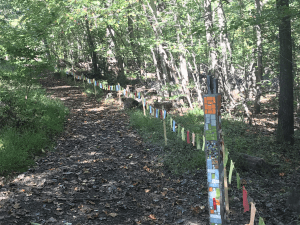
You are invited to expand your prayer experience as you walk along the short SJN Prayer Loop behind the church, new as of this summer. If you can’t come in person, take this 3-minute virtual walk and add a blue prayer flag with your private intention.
The entrance to the prayer loop is at the far right, rear corner of the church at the end of the side parking lot (between the church and the rectory). Sample prayers are in the prayer box. We hope you enjoy finding prayerful uses of the sacred space.
Season of Creation 2020 Prayer Service
We invite you to join a virtual 17-minute outdoor prayer service celebrating the Season of Creation filmed at the outdoor amphitheater behind St. John Neumann.
As we have come to learn, it takes a special effort to be spiritually present in a virtual service and to overcome the stance of being a casual observer of a production.
Please begin by centering yourself, taking a few deep breaths and asking for the graces to participate prayerfully.